Best Game Art Outsourcing Companies in 2026: Top Studios for Your Project
The gaming industry has a production problem that is impossible to get rid of. The expectations people have about visual quality is rising every year, and they want to see it as standard. Release windows are getting tighter and the cost of keeping a full in-house art department for a full year has become difficult to justify.
Game art outsourcing comes as a solution. About 60% of game studios outsource art tasks, because they need specialized skills and are looking for cost efficiency. Customers can contract external studios to create visual assets for their projects. It can be everything from characters, environments, UI or UX elements, animations, concept art, and bigger things.
It might seem from a first glance as a shortcut. It is true, partly. But as a bigger picture, it’s a deliberate production strategy that lets clients get use of specialist skills on demand.
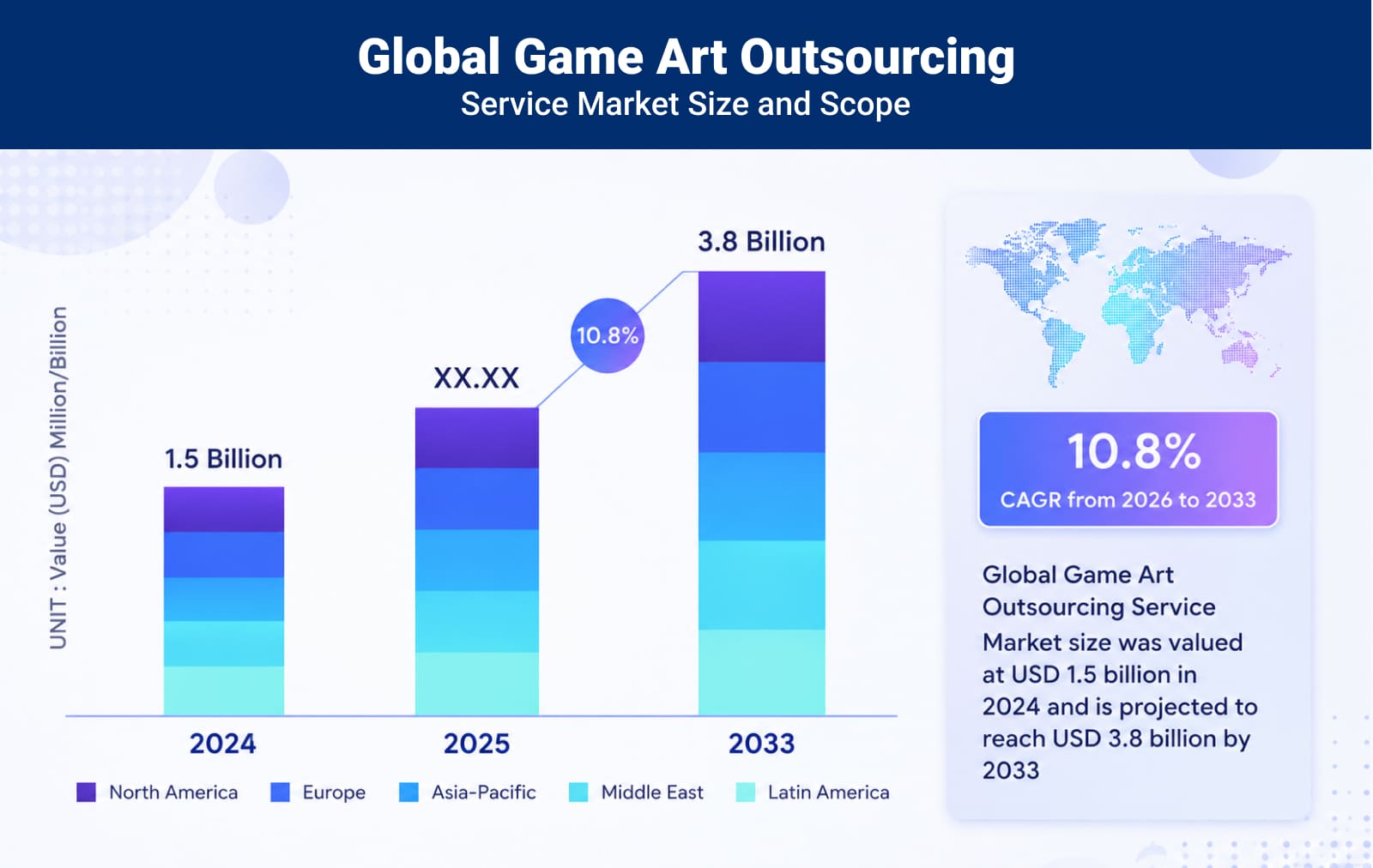
In 2026, video game art outsourcing has become a mature practice. The market has enlarged with studios that offer small concept art, deliver custom 2D or 3D, and there are a lot large-scale production partners. Number-wise, analysts predict the game art outsourcing market to reach USD 3.8 billion by 2033, growing at a CAGR of 10.8%.
With so many options, what’s the challenge then? The answer would be to find the right partner for your specific project, budget, and workflow.
We prepared a list of the best game art outsourcing companies working today. As a foundation, we used criteria that actually matter in production: portfolio depth, communication reliability, technical pipeline compatibility, and delivery track record. Alongside the list, you’ll find what to look for when evaluating a studio, and how 2D and 3D outsourcing differ and when each applies.
Key Takeaways
- Game art outsourcing is standard practice for studios of all sizes in 2026.
- The gap between a reliable game art outsourcing company and an unreliable one shows up in communication, revision handling, and how they behave when something goes wrong mid-project.
- 2D and 3D game art outsourcing require different evaluation criteria. 2D work depends completely on style consistency; 3D provides technical complexity around poly count, rigging, and engine compatibility.
- A well-run outsourcing partnership has a structure that includes brief, following a client’s style, delivery based on goals, and feedback loops.
- Outsourcing game art doesn’t mean handing off creative control. The best partnerships have tight briefs and regular checkpoints.
Why Game Art Outsourcing Has Become Standard Practice in 2026
A few years ago, outsourcing art was only something studios would do out of necessity. If they were behind schedule or couldn’t afford to hire, outsourcing was the answer.
In 2026, game art outsourcing is a production decision that exists in project plans from the start for studios, publishers, and product companies alike. It is not some urgent measure that helps to save a project, but a deliberate step companies take.
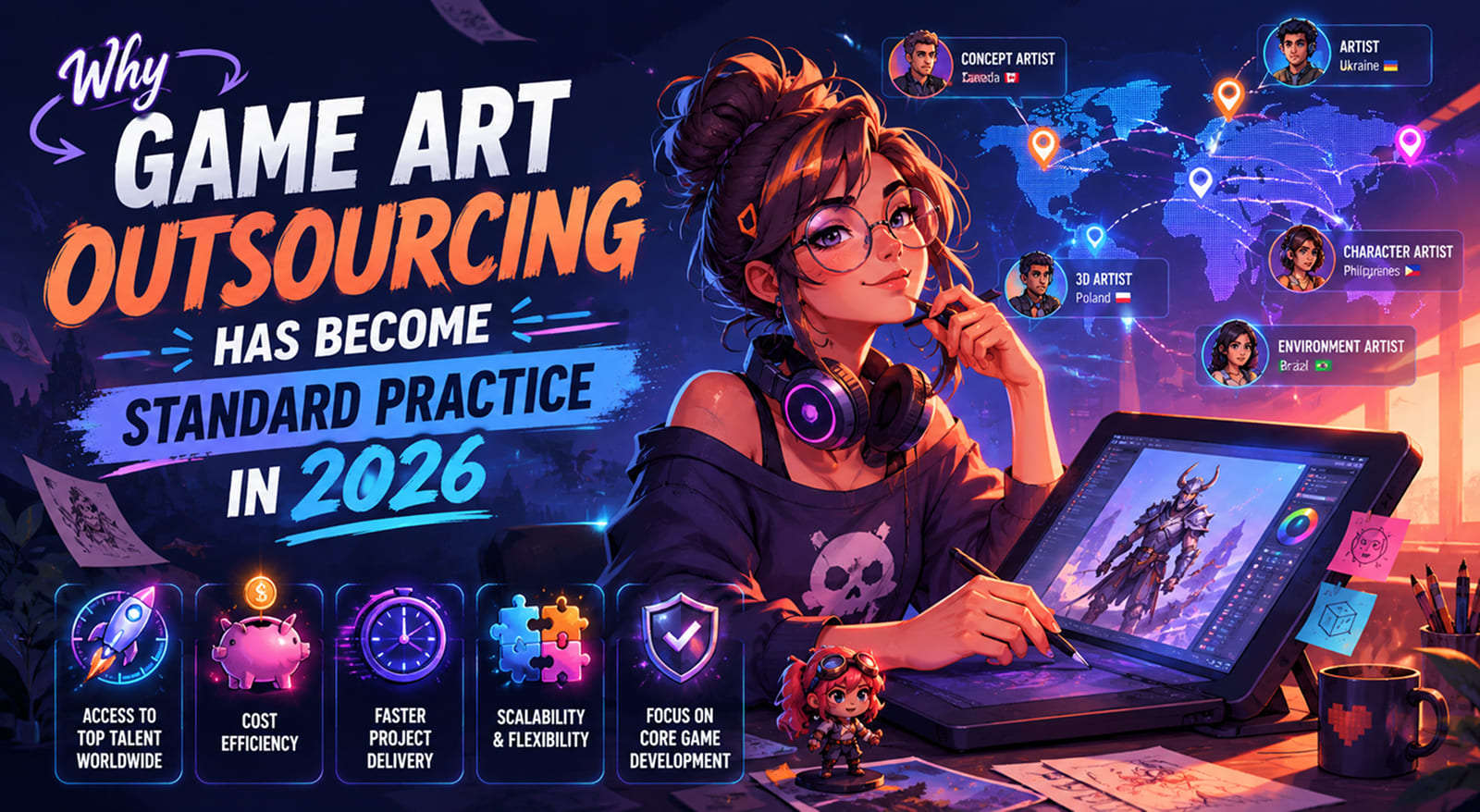
The numbers reflect it. The global game art outsourcing market was valued at over $3.7 billion in 2023 and is projected to grow at a compound annual growth rate of around 10–12% through 2028.
The expansion of mobile gaming, and also the rise of live-service titles that can’t exist without ongoing content production, affects this growth.
Let’s take a look at the forces behind that growth:
Visual expectations have changed permanently. A mobile RPG released today is being compared (consciously or not) to the best-looking games in the genre. It might sound harsh, but nobody cares whether those were made by a 300-person studio or a team of twelve.
The premium indie releases of the past few years only made expectations higher. AI-assisted art tools have pushed that bar further still. Concept generation, texture work, and lighting iteration can now be prototyped in days. Players may not know how a game was made, but they notice the result.
Achieving such a high level of visual quality requires specialist talent:
- Concept artists who can define a world’s visual language
- Character modelers who understand silhouette and LOD
- Environment artists who know how lighting will interact with every surface
Hiring all of those disciplines in-house for a single project is just a waste of budget. Video game art outsourcing gives access to those specialists and it doesn’t come with the need in taking these people on the payroll.
The economics of in-house art teams don’t scale well. A full-time art department is a fixed cost. There are too many things: salaries, equipment, software licenses, benefits, and management overhead. Those numbers stay the same whether the team is at peak production or waiting for the next project to start working on. And if a studio is not continuously shipping, that gap between projects is enormously expensive. Which is also one of the clearest financial arguments for working with game art outsourcing companies. In the end, you don’t have to pay for the capacity you don’t currently have use for.
Specialization has become more granular, and that’s a problem for generalist hiring. The art disciplines that go into a modern game are very specific and they do require unique sets of skills. They are not interchangeable.
A UI designer who can build a clean HUD is unlikely to be equipped to handle environment art for an open world. Expecting to cover the full range of visual production needs with a small in-house team means working with generalists. But that also means you will have people who will work in different disciplines without a proper, narrow enough expertise.
Outsourcing game art gives customers access to more narrow specialists.
Did You Know? 3D art makes up roughly 55% of contracted outsourcing work, with 2D art accounting for the remaining 45%.
Production timelines don’t have much slack left. Release schedules have compressed, and the expectation of regular content updates for live-service titles means the work doesn’t stop at launch. Running art production in parallel, outsourcing asset creation while the core team handles everything else, is how studios work. A dedicated game art outsourcing studio focused only on asset delivery can make work really fast.
What to Look For in Game Art Outsourcing Studio
The main question is what the right studio partner possesses. What should you look for when you are only planning to include an outsourcing studio for a project?
- Portfolio quality and style range. Basic requirement that can’t be missed. Check if there is quality across 2D and 3D work, and how their quality differs from project to project. Check what art styles the studio is literate in working with: realistic, stylized, pixel art, cartoon, etc. A narrow portfolio doesn’t always mean the outsourcing partner will do bad, but it is a risk. They might just not be familiar with your project style and deliver work beyond your expectations.
- The usage of AI. It is important to see if companies are using AI and how exactly they incorporate it into their pipelines. Some studios use it responsibly: for concepting, mood boarding, or speeding up repetitive texture work. They are still keeping human artists in control of final output. Ask directly how AI fits into their workflow.
- Service breadth (concept art, modeling, animation, UI). This is, again, a question of specialization. Some studios specialize; others offer end-to-end art production. At this point, you have to understand which one is suitable for you, and which fits your current workflow better.
- Pipeline compatibility with your project. Nothing breaks a creative cycle like the need to rework things. Assets delivered in the wrong format, with incorrect LODs, wrong naming conventions, or untested in-engine will create that rework. Moreover, it won’t be cheap. So, confirm the studio delivers engine-ready assets, and then move to the next stage with them.
- NDA and IP protection. Any reputable outsourcing company will sign an NDA before work begins. This is a standard procedure, nothing more. However, if the outsourcing studio refuses to do that, you might want to reconsider collaboration. Verify their data security practices, especially if sharing unreleased game concepts or proprietary IP.
- Scalability. Can the studio flex team size up or down based on production phase? Partners that can scale with sprint demands are valuable ones. They can bring more than fixed-team vendors. If you want to outsource game art make sure to assess scalability potential.
- Communication and project management. These are the things that affect delivery quality. If there’s no time zone alignment, for instance, or response times are unnecessarily long, it can lead to poor results, too. Poor communication is the most common reason outsourcing partnerships fail.
- Client references and reviews. Check Clutch, GoodFirms, or direct references. Past client experience tells you more than a portfolio only, and you can build a bigger picture for yourself.
Top 10 Best Game Art Outsourcing Companies in 2026
When selecting this list, we used Clutch ratings as one of the most important factors of evaluation. Portfolio depth, client testimonials, and service range were criteria that completes a picture. Finally, we’ve added only studios that demonstrated experience across project types and platforms.
Tip: Before signing any agreement, ask the studio to show you an asset they delivered engine-ready according to your requirements, game engine or current project.
1. Fgfactory
📍 Ukraine; Australia | Founded: 2010 | Team: 60+ specialists
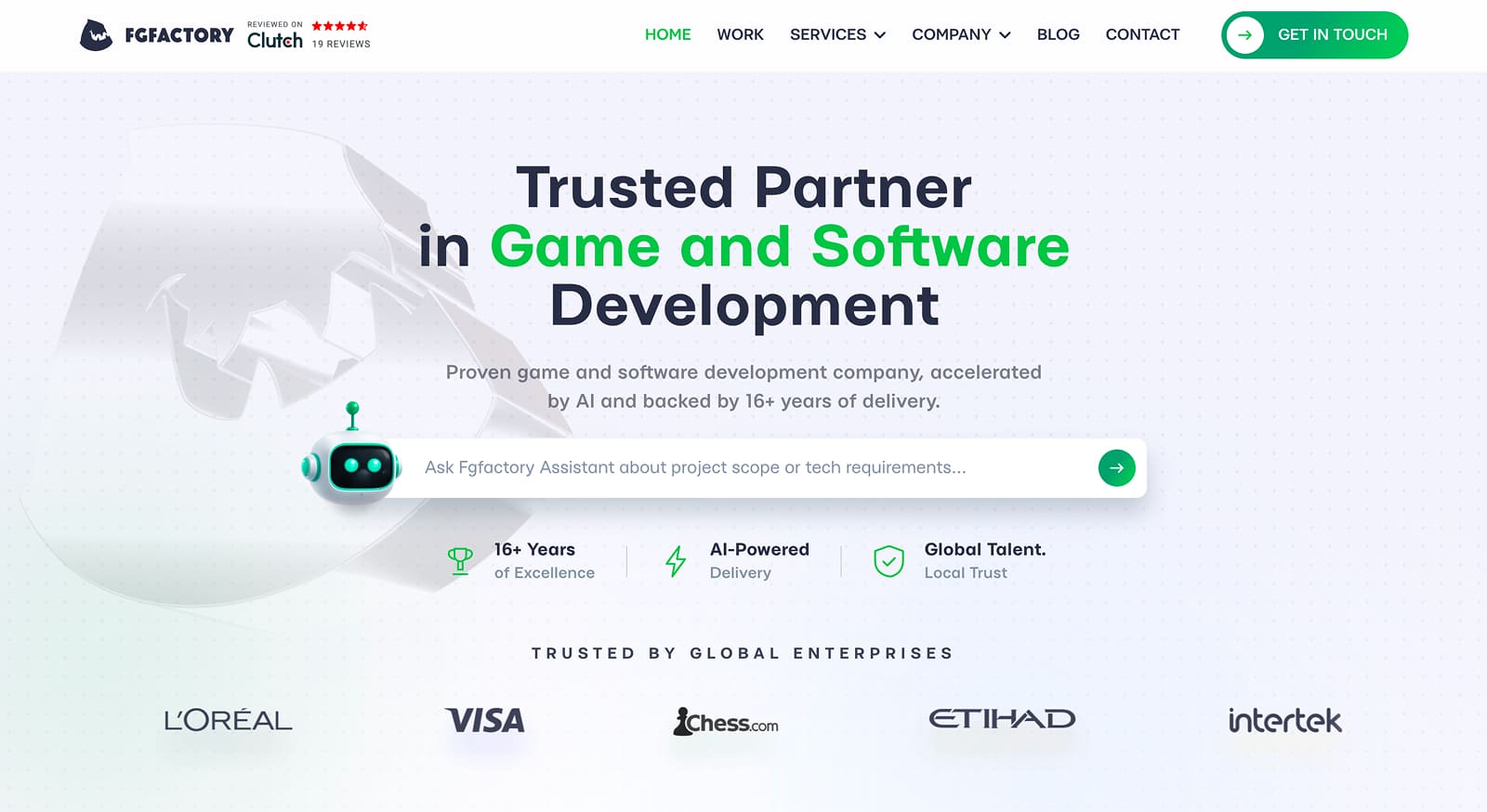
Fgfactory is a full-cycle game art outsourcing studio producing 2D and 3D art, animation, UI/UX, and motion design for gaming, entertainment, and advertising clients worldwide. This is not one of the large generalist studios. They have a focused, senior-heavy team with dozens of years of expertise in art styles. They delivered cartoon, semi-realistic, realistic and many more titles. One of the most interesting things about this company is their dual offering of game development and art services. It means they understand how assets land in-engine, and they know very well how to create them from scratch. This makes them one of the top game art outsourcing companies.
Core services: 2D game art, concept art, 3D assets, 2D animation, UI/UX, motion design
Notable clients / projects: Chess.com, Maybelline New York, Visa Azerbaijan, Bolt Betz, Etihad
Best for: Studios and publishers that are looking for highly experienced, senior-level game art outsourcing across 2D and 3D disciplines. Also, clients who want direct communication without overhead of a 500-person vendor.
2. Kevuru Games
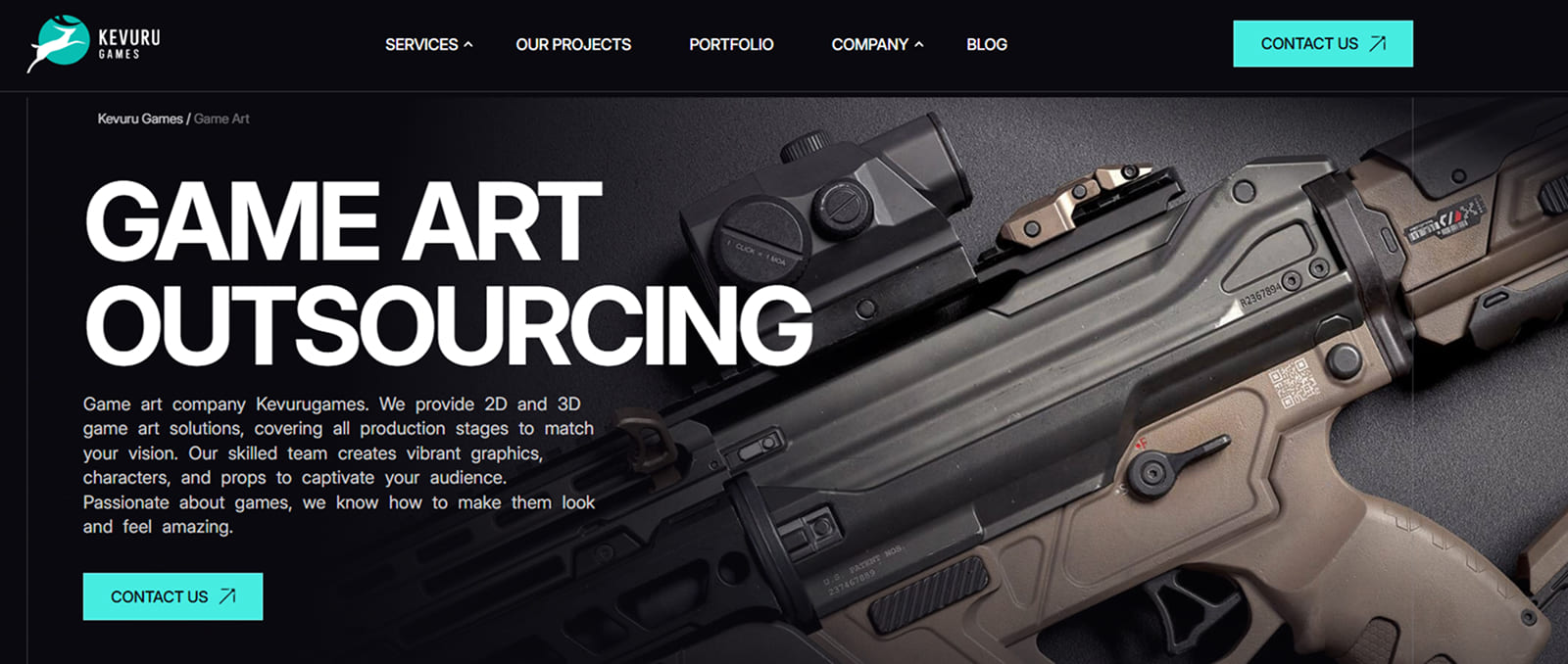
📍 Poland; United States | Founded: 2012 | Team: 300+ specialists
Kevuru Games is known for having partnerships with industry leaders. EA, Housemarque, and Bandai Namco, all these big names appeared in partnerships posts, with an average client collaboration lasting over three years. Such a number shows that the studio has thriving relationships with its clients.
Kevuru games practices a dual model: traditional project-based outsourcing comes with dedicated outstaffing. Clients can hire individual artists or developers right into their own team.
Core services: 2D/3D art, concept art, character and environment design, Spine animation, UI/UX, full-cycle game development
Notable clients: EA, Bandai Namco, Epic Games, Housemarque, Disney, Lucasfilm, Bytro
Best for: Studios needing a flexible 3D game art outsourcing company that can operate as a full production partner. A strong fit for those looking for individual specialists to get depending on the project phase.
3. Room 8 Studio
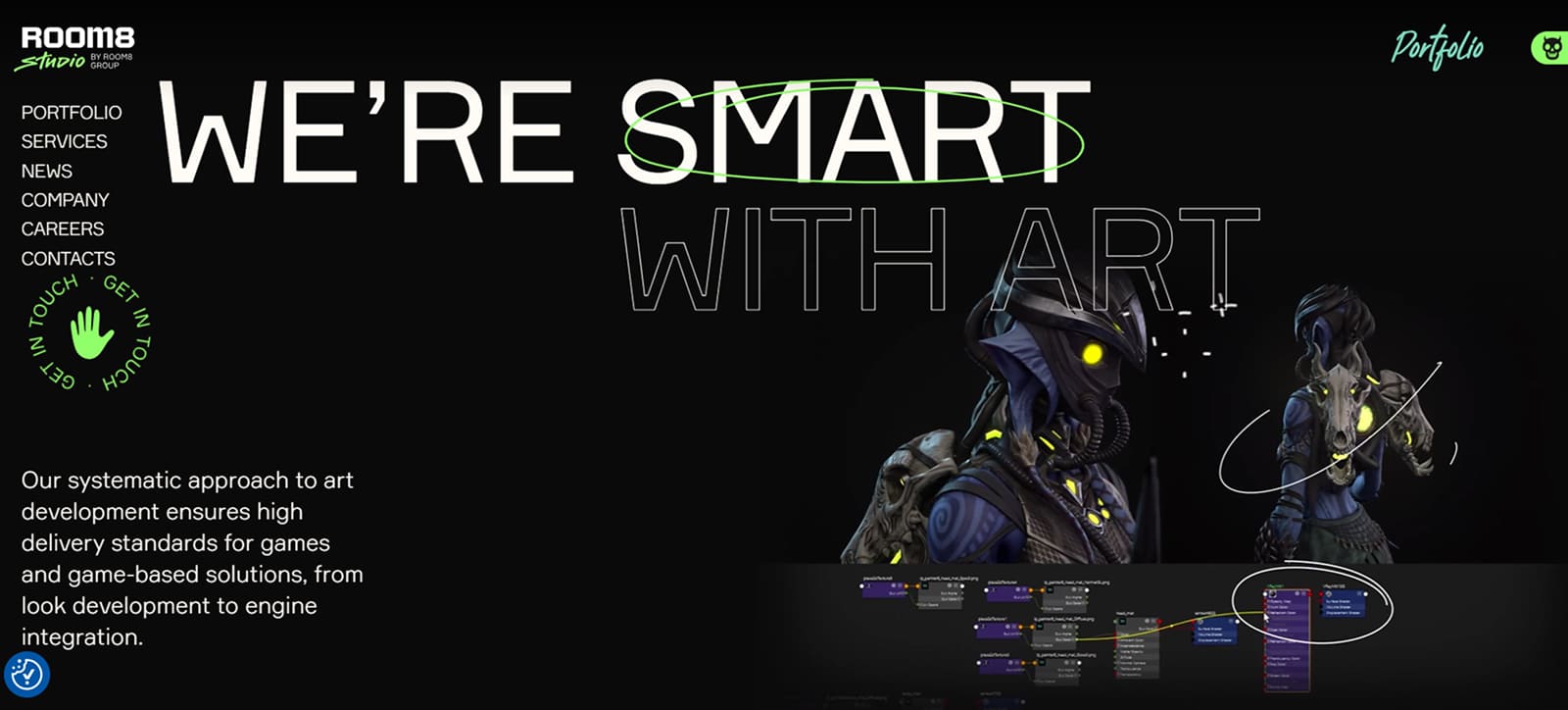
📍 Ukraine (founded); Europe, North America, South America | Founded: 2011 | Team: 1,000+ specialists
Room 8 Group is a game art studio founded in 2011, with over 1,000 specialists across Europe, North America, and South America. The studio is ISO 27001 certified for information security, which matters when sharing unreleased IP with an external team. They offer end-to-end art production, including early concept as well as final engine-ready assets.
In 2024, the studio worked on over 320 projects. Room 8 is ISO 27001 certified for information security, which is a big thing.
Core services: Concept art, 2D/3D character and environment art, animation, VFX, cinematics, trailers, UI/UX
Notable clients: Activision, Ubisoft, CD Projekt Red, Riot Games, Blizzard, Nintendo, Sony, SEGA
Best for: Mid-to-AAA productions that need high-volume video game art outsourcing for characters, environments, and cinematics all at the same time.
4. Juego Studios
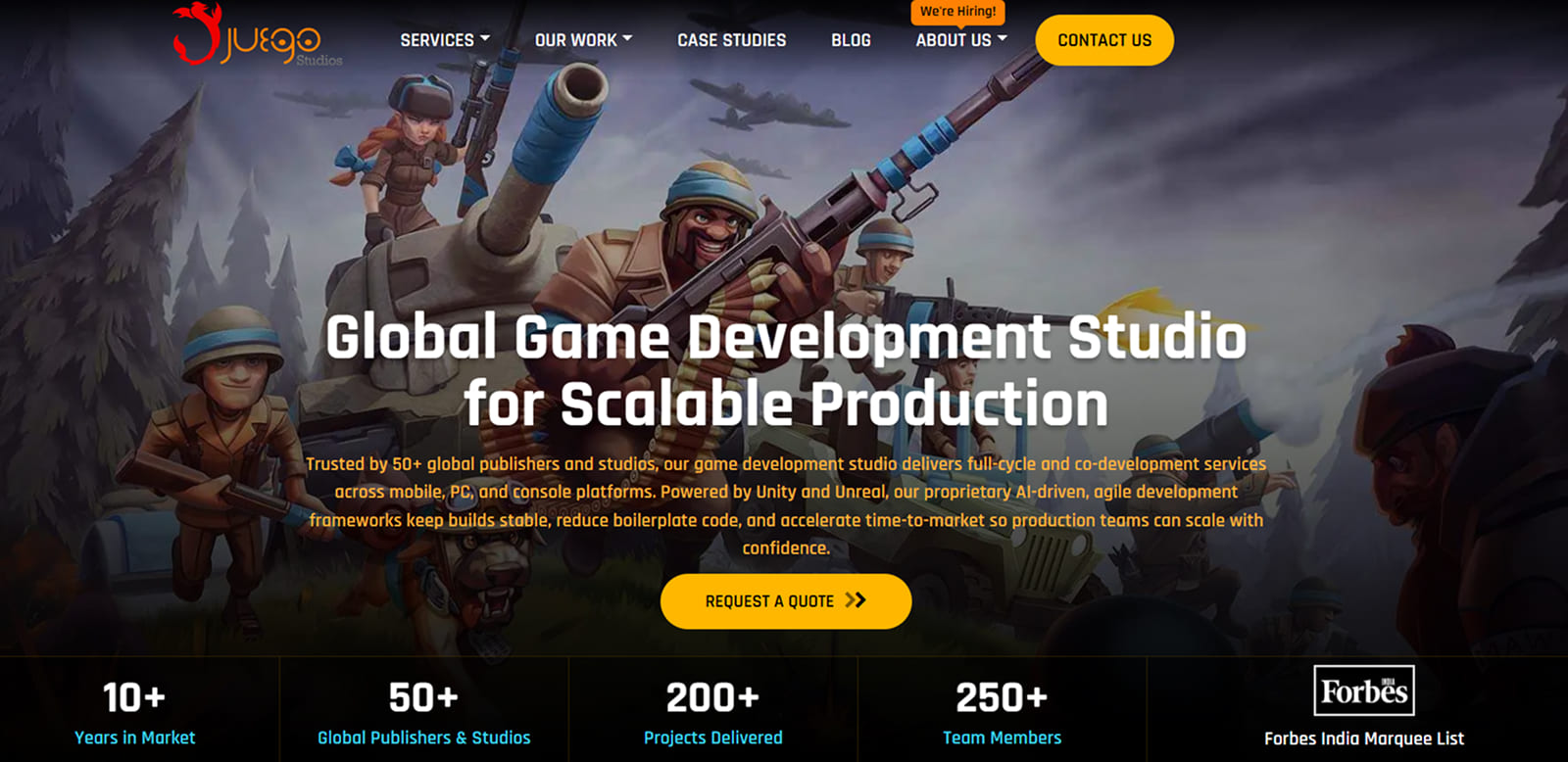
📍 India; United States; United Kingdom; Saudi Arabia | Founded: 2013 | Team: 300+ specialists
Juego Studios is a team of more than 300 professionals with over 10 years of experience. Their portfolio consists of mostly top-tier clients like Sony, Disney, and Amazon. Their production model is built around dedicated teams assigned at project start, and maintained through delivery.
Each asset is checked against naming conventions, UV standards, material specs, and engine import requirements before reaching the client team, which addresses one of the most common practical failures in outsourcing at scale.
Core services: 2D and 3D art, concept art, character design, environment design, animation, VFX, UI/UX, AAA art production
Notable clients: Sony, Disney, Amazon, Wicked Witch; projects include NBA2K21
Best for: Mid-size to AAA studios that are looking for pipeline-compatible game art outsourcing with reliable technical handoffs. Strong choice for clients looking for consistent team assignment during a full production cycle.
5. RetroStyle Games
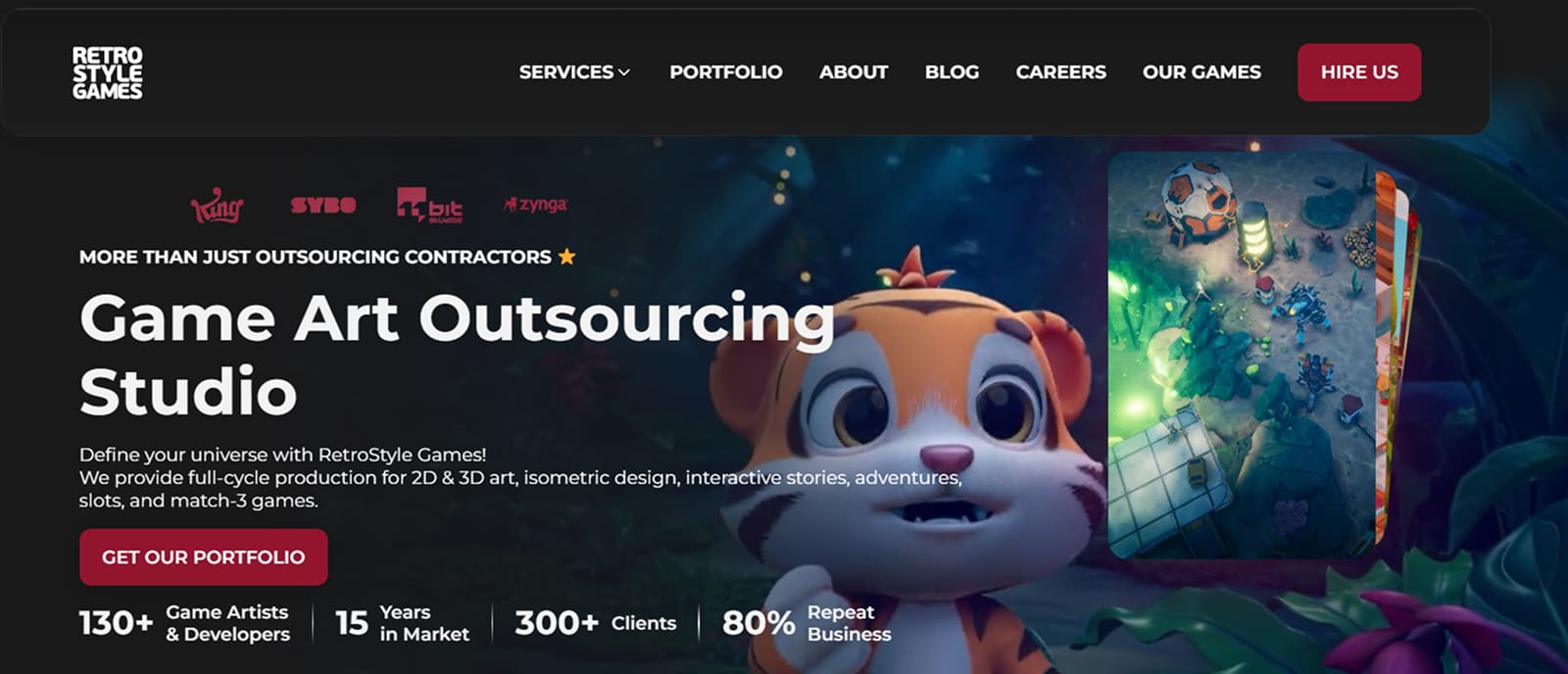
📍 Ukraine; Cyprus | Founded: 2010 | Team: 140+ professionals
RetroStyle Games has a very specific position in the gaming world. Not only does this company develop its own games, but the team uses that production experience to become a better outsourcing partner.
They have created art for games with over 250 million downloads. RetroStyle games are known for being good in isometric art, match-3 visuals, and casual mobile game aesthetics.
Core services: 2D and 3D art, concept art, isometric asset creation, character animation, Unity integration, level design
Notable clients: Ubisoft, Disney, Gamegos, Haiku Games
Best for: Indie and mid-size studios that are looking for a reliable 2D game art outsourcing studio for casual, mobile, and isometric game art with genuine game development intuition behind the output.
6. N-iX Game & VR Studio
📍 Ukraine; Malta; USA; UK; Poland; Sweden; Colombia | Founded: 2012 | Team: 240+ specialists
N-iX Game & VR Studio is the games-focused branch of a large Eastern European software engineering group. That means they have a few big, and rather unusual advantages. There’s a combination of deep art production and high-level technical infrastructure.
They have created 1,000+ 3D models for games including big names like World of Tanks. What’s also worth noting is their VR and metaverse abilities.
Core services: 2D/3D art production, character and environment modeling, animation, motion capture clean-up, VR/metaverse solutions, full-cycle co-development
Notable clients: Wargaming (World of Tanks), Supermassive Games (The Devil in Me), Microsoft Xbox, Sony PlayStation, Nintendo Switch
Best for: Studios developing VR, metaverse, or technically demanding 3D titles that need a game art outsourcing studio equipped with deep engineering infrastructure. A great choice for studios looking to create games outside of flat screens.
7. 3D-Ace Studio
📍 Cyprus; USA; Poland; Ukraine; Slovakia; Hungary | Founded: 2009 | Team: 40+ specialists
3D-Ace is a smaller studio than most on this list, which makes them useful for a specific type of client. The studio has grown into a team of 40 with expertise in 2D art, 3D modeling, technical art, and animation.
They show production stability without having too much staff that is usually inherent to a large production house. Their work on Roblox, AR/VR, and non-gaming visualization projects proves that they are a good option for studios operating outside traditional game formats.
Core services: 3D modeling (low and high poly), concept art, 2D art, character design, environment art, animation, rigging, AR/VR assets
Best for: Indie developers and mid-size studios who are looking for a senior-led 3D game art outsourcing company for characters, environments, and assets done with Unity and Unreal pipelines.
8. Lemon Sky Studios
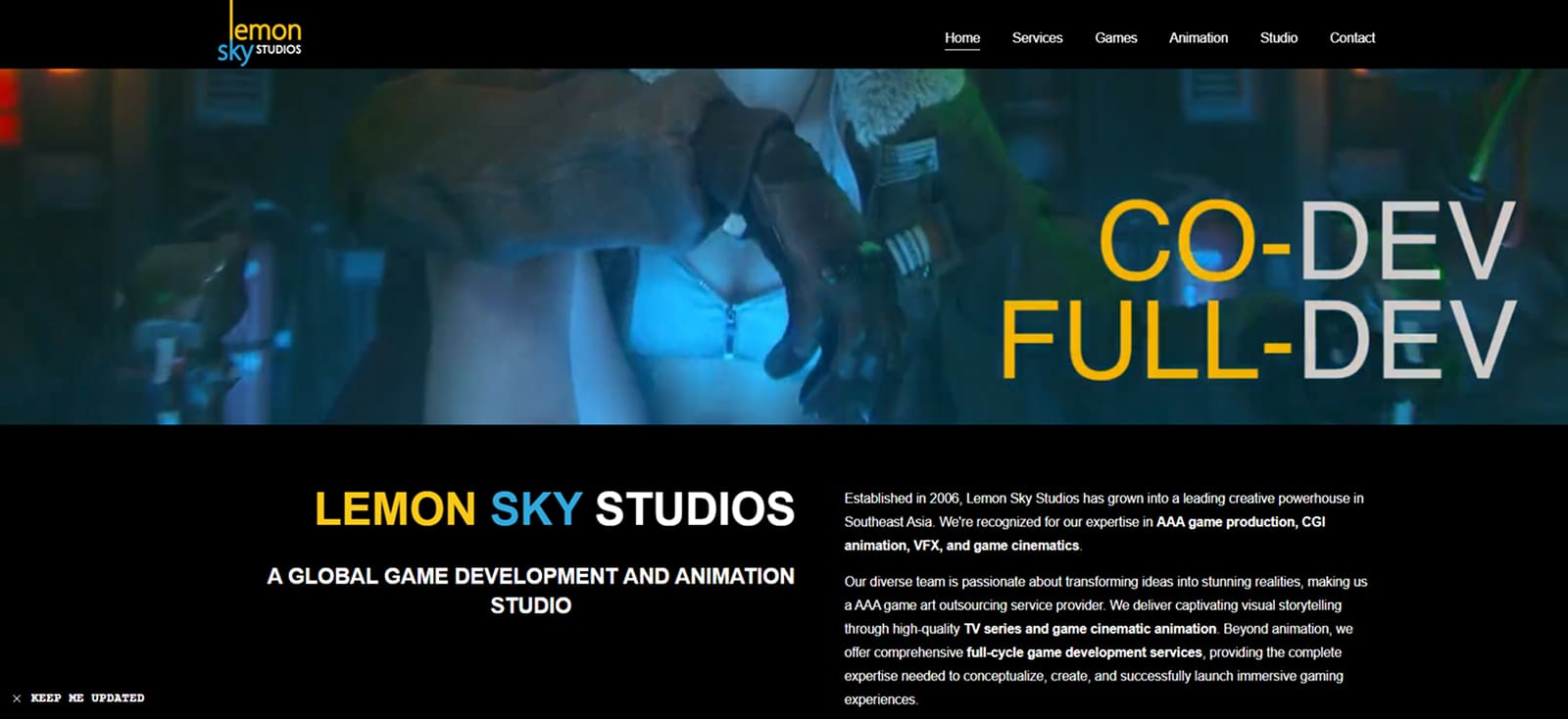
📍 Malaysia | Founded: 2006 | Team: ~500 specialists
Established in 2006, Lemon Sky Studios has grown into a big creative company in Southeast Asia. Their expertise in AAA game production, CGI animation, VFX, says a lot about the level of expertise this studio has.
Lemon Sky demonstrates that world-class video game concept art outsourcing and 3D production are not dependent on geography.
Core services: 3D art and animation, concept art, CGI cinematics, VFX, game cinematic production, IP development
Notable clients: Square Enix, Naughty Dog, Blizzard, Capcom, Insomniac Games, Bandai Namco, Disney, Microsoft
Best for: AAA publishers and developers needing cinematic-quality 3D asset production and VFX at scale.
9. RocketBrush Studio
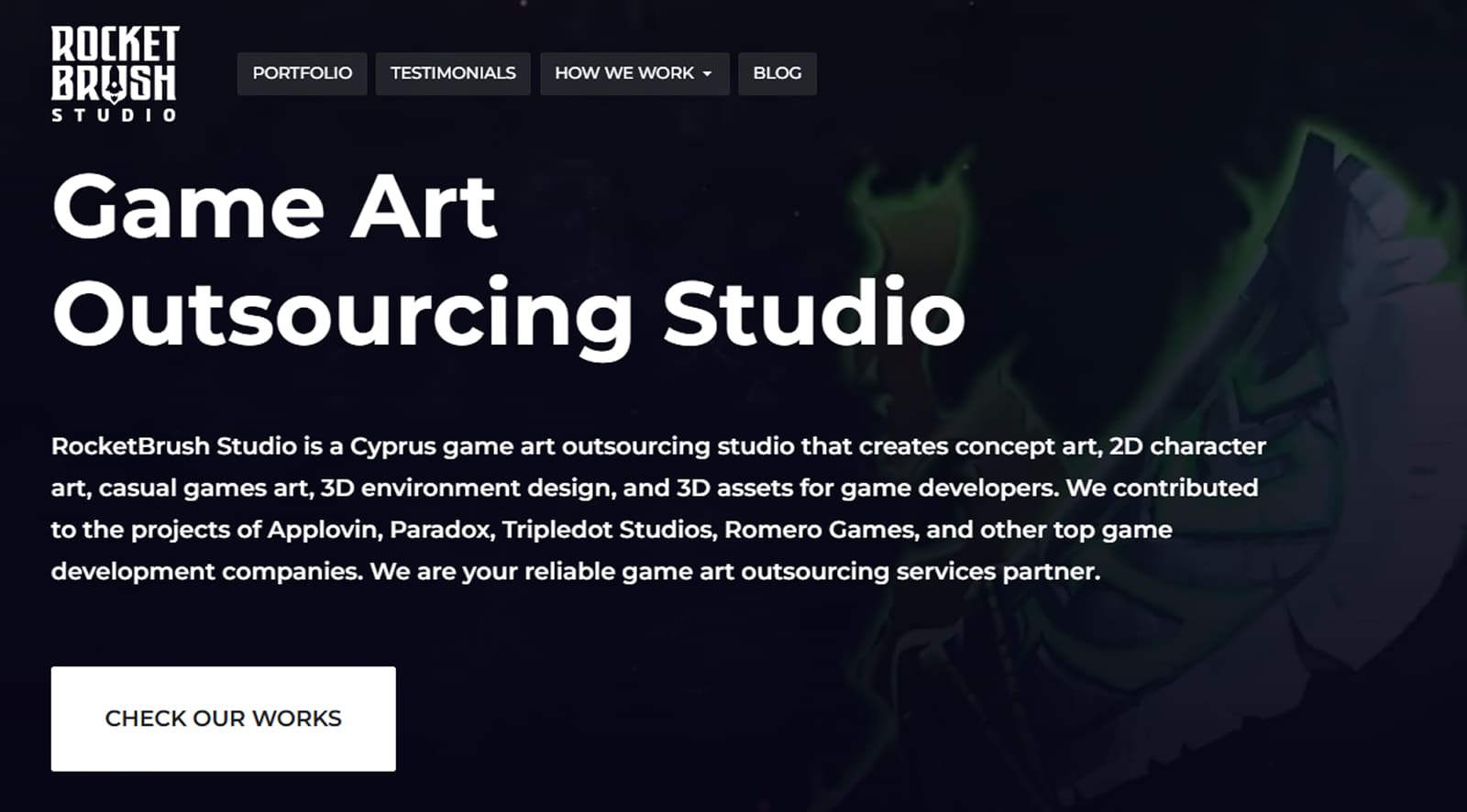
📍 Cyprus | Founded: 2016 | Team: ~35 specialists
RocketBrush is a boutique 2D game art outsourcing studio that has completed 150+ projects for 100+ clients while staying small on purpose. It is rather a structural choice that allows senior artists to be directly involved in production. It also frees them from managing junior pipelines.
Their main focus is casual and mobile game art outsourcing: concept art, 2D characters, match-3 visuals, icons, and UI for mobile and PC developers.
Core services: Concept art, 2D character art, casual game illustrations, match-3 and mobile art, UI/UX icons, 3D environment assets
Notable clients: Supercell, Playrix, AppLovin, Tripledot Studios, Kwalee, Zeptolab, Wooga
Best for: Indie and mobile studios who want fast results and high-quality mobile game art outsourcing. A match for those who need direct access to senior artists and a lean production structure.
10. Starloop Studios
📍 Spain | Founded: 2011 | Team: 200+ specialists
Starloop Studios has been a leading force in the mobile game development industry for a decade. Their numbers are impressive: the team has crafted over 300 games.
Now operating under the Magic Media group, they have art production combined with full-cycle development capabilities.
They are seen mostly as mobile game art outsourcing partners, but they have done work across different formats like VR and PC.
Core services: Concept art, 2D/3D character and environment art, animation, full-cycle game development, VR/AR, game porting
Notable clients: Verifiable credits include Hello Kitty Merge Town (Scopely)
Best for: Studios that need mobile game development from an experienced game art outsourcing studio that can handle art production and development in the same engagement.
2D vs 3D Game Art Outsourcing: How to Choose the Right Specialization
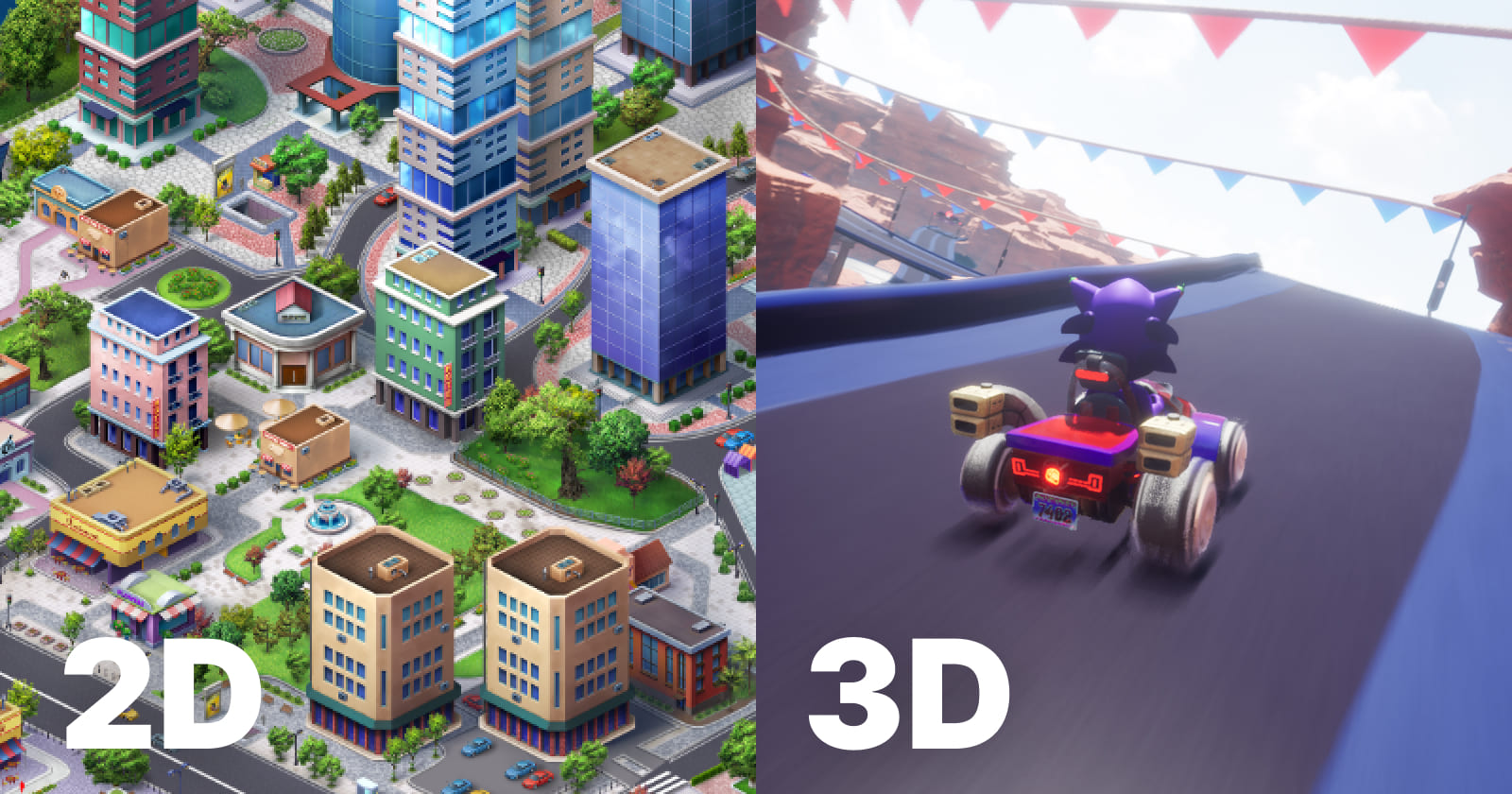
When it comes to outsourcing, it is easy to get confused, especially when the production goals are complex. Many studios approach outsourcing without really knowing what they need: 2D or 3D studios, mix of both, or something even more different. Let’s see what you need to know when selecting your outsourcing partners.
- When 2D outsourcing is the right choice: if you need a partner who can help much with creating mobile games or casual and hyper-casual titles. Other projects that would benefit from 2D specialists are side-scrollers, card games, UI-heavy projects. It is especially important to look for 2D outsourcing when you are working on games with a stylized or hand-drawn aesthetic. Now, why do you specifically need a 2D game art outsourcing company? One of the main reasons is the fact that these studios usually are very good at illustration and character sheets. They add quality sprite work, and they know how to work well with UI design.
- When 3D outsourcing is the right choice: When you are creating console and PC games, first/third-person titles, simulation, and open-world games. It is also highly important for VR experiences, and any project requiring environmental depth. 3D outsourcing companies also bring experience of working with character rigs, or cinematic cutscenes. 3D studios bring a lot of mastery in modeling, sculpting, rigging, texturing, and real-time rendering. These are the things impossible to miss if you want to deliver a high-quality title.
- When you need both: many projects, especially mid-budget mobile RPGs, strategy games, and cross-platform titles can’t function well with just one of these services. They require 2D concept art and 3D asset production. The best option here is to choose a full-service studio that covers both of them well.
Your job is to understand what is your game’s primary visual language, even if you are considering top game art outsourcing companies.
If you can identify that early in pre-production, finding the right studio will be much easier, because you can apply your requirements as a filter.
Did You Know? Many successful mid-budget mobile RPGs and strategy titles use both 2D and 3D art in the same pipeline. 2D for UI, icons, and concept work, 3D for characters and environments.
How to Start Working with a Game Art Outsourcing Company
Once you find an outsourcing partner, the next big question is how to actually structure the way you work with them.
- Prepare a detailed art brief. Before you outsource game concept art, you need to prepare a ground for your future partner, and, in a way, make things easier for them. Start by documenting your art style references and technical requirements (engine, poly budgets, texture resolution). Then, create an asset list, timeline, and budget range. One important thing to remember is that you won’t get the best results, if your brief is vague. The more precise your brief, the better the final results will be.
- Research and shortlist studios. There are many reasons to familiarize yourself with the work of various studios. Clutch, GoodFirms, and ArtStation Studios, (and don’t forget about direct search) might be enough to build a shortlist of 3-5 candidates. Be careful to look for portfolio work that actually fits two things: your goals and art style. Overall quality is important, but it is just a baseline. Even top game art outsourcing companies have to be matched with you.
- Request proposals and compare. Once you have candidates to work with, send your brief to them. Ask for a project quote, estimated timeline, team structure, and sample workflow. You don’t need to know more at this point, and your goal now is to compare options. Compare everything you find important, but also their communication, too. It is as important as the portfolio or price.
- Run a paid test task. Don’t jump straight into a full contract, even if you like everything. Start from a small defined test piece. It could be just one character, or a UI screen, something that can give you a feeling of collaboration. This is a low-risk interaction that will show what your partnership might look like.
- Sign an NDA and contract. This is a basic, yet highly important part of pre-work. Non-disclosure agreement and a production contract should cover a few important things, clarify them essentially. It’s scope, milestones, payment terms, revision rounds, and IP ownership. Highly recommended not to start the production process without these, and not continue working with a partner that refuses to sign it.
- Kick off production with an art direction session. When starting a production, you need a dedicated kickoff call or at least a document to make sure you are on the same page regarding a style guide. Include reference materials, tools, communication cadence, and delivery format. Nothing really works without this simple step, or can cause a lot of unnecessary stops.
Tip: Keep your test task scoped to something that genuinely reflects the hardest part of your project. If your game has complex character expressions, test that. A test that doesn’t stress-test the studio’s actual weak points gives you false confidence.
Final Thoughts
Choosing the right game art outsourcing company is a well-practiced step. It is a strategic production decision that helps to move forward more efficiently, and the reasons are not coming from cost-saving considerations.
If you are looking for a reliable game art outsourcing studio that has delivered mobile, PC, and console projects since 2010, our team is ready to talk.

 Loading...